 Visualization
Napkin Caddy SVG, Sloped Table Organizer Laser Cut File, Straw and Coaster Holder DXF
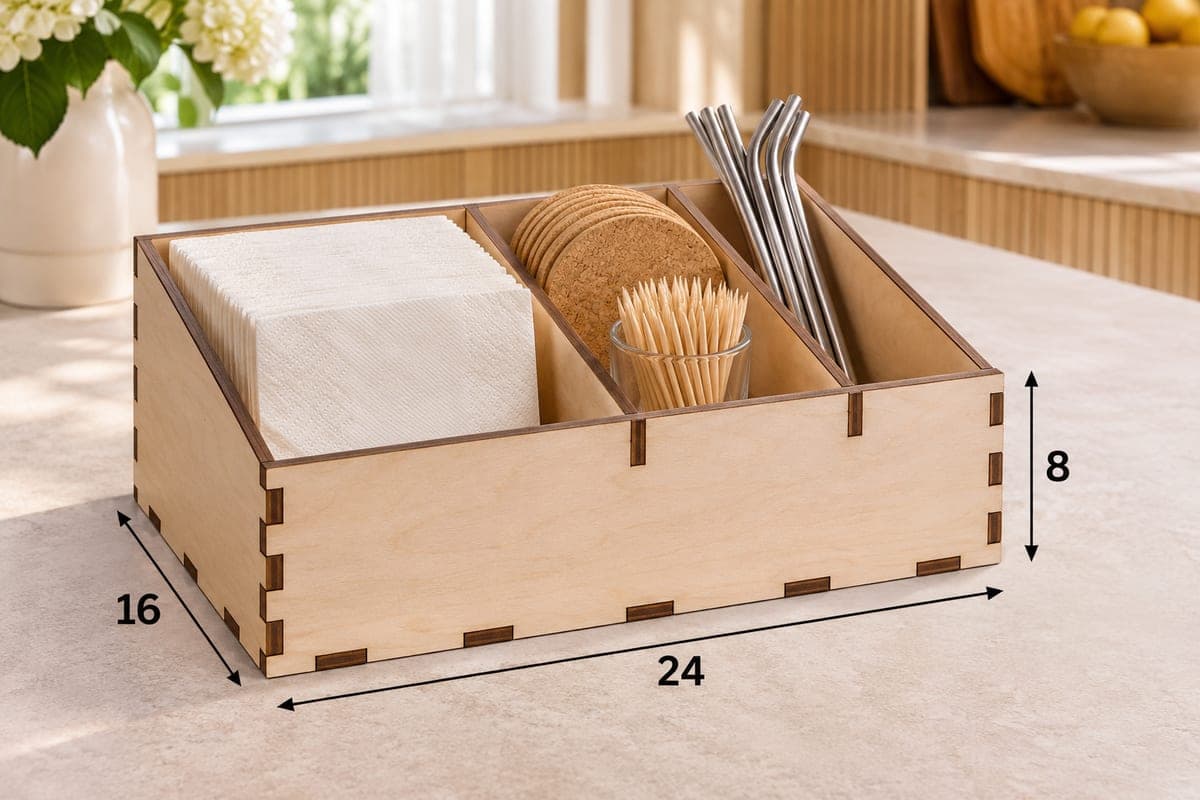
A free open napkin caddy for the table or kitchen counter, with three side-by-side sections and a low front that slopes up to a taller back. The download has SVG and DXF files for 3, 4, 5 and 6 mm plywood; the box measures 240 × 160 × 80 mm (9.45 × 6.30 × 3.15 in) and is made of 7 pieces joined with tabs and slots.
- Formats
- SVG, DXF
- Outer size (W × D × H)
- 240 × 160 × 80 mm (9.45 × 6.30 × 3.15 in)
- Parts
- 7
- Material thickness
- 3, 4, 5 or 6 mm plywood (a file for each)
- Layout size (3 mm file)
- 820 × 252 mm
- Cut length
- 4.38 m
- Est. time, 10 W diode (3 mm)
- 14 min 35 s
- Est. time, 40 W CO2 (3 mm)
- 6 min 05 s
- Layers
- CUT only, no engraving
Free account required to download
How to make it
- 01Pick the SVG or DXF that matches your plywood thickness and cut one tab and slot from scrap to check the fit.
- 02Cut all 7 pieces from one 820 × 252 mm layout, or split them over two smaller sheets.
- 03Seat the back and the two sloped side panels in the base, slide in both dividers, then press the short front into place.
- 04Sand the edges, oil or lacquer the wood, and load napkins on the left, coasters in the middle and straws on the right.
What goes in the three sections
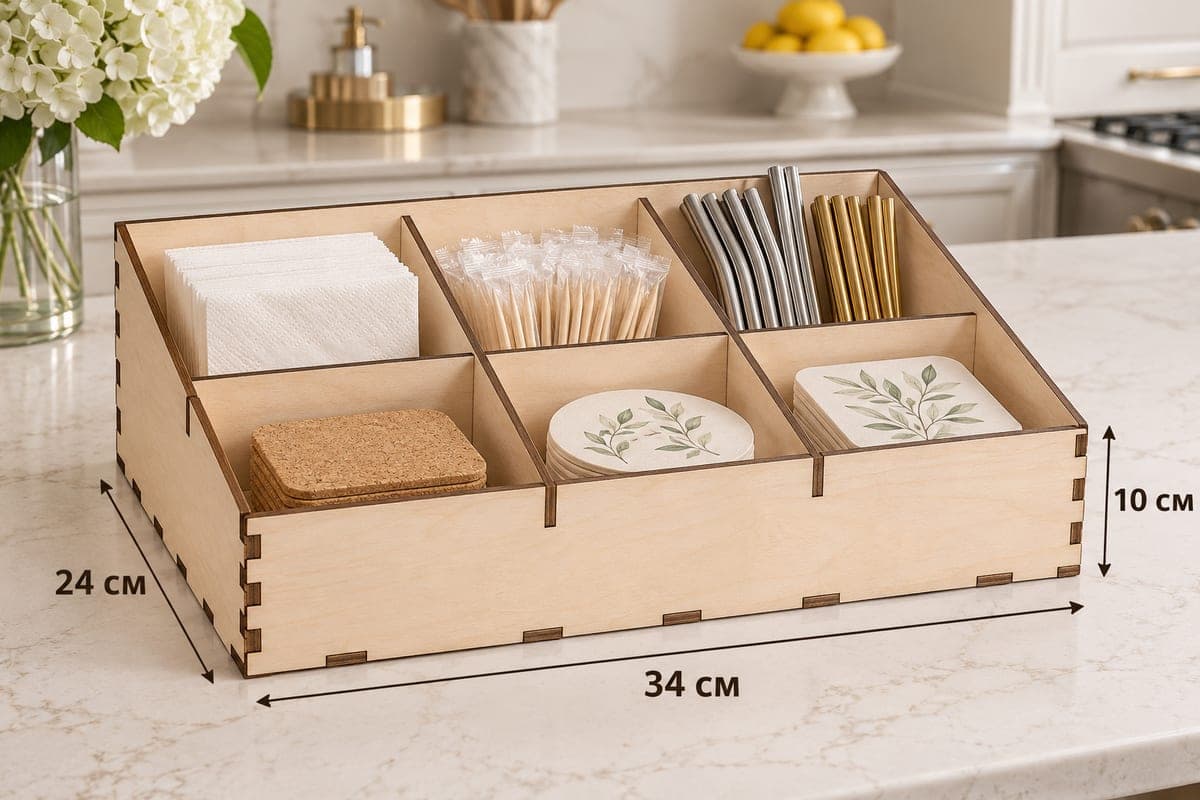
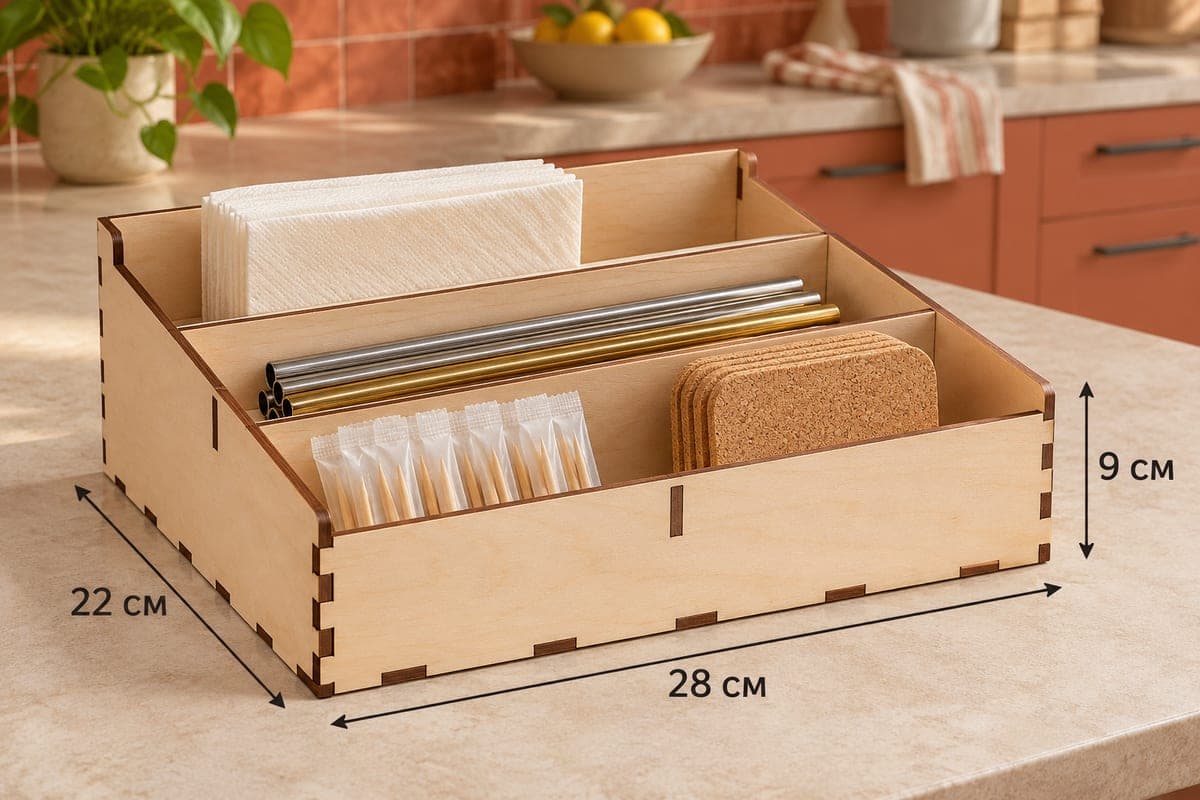
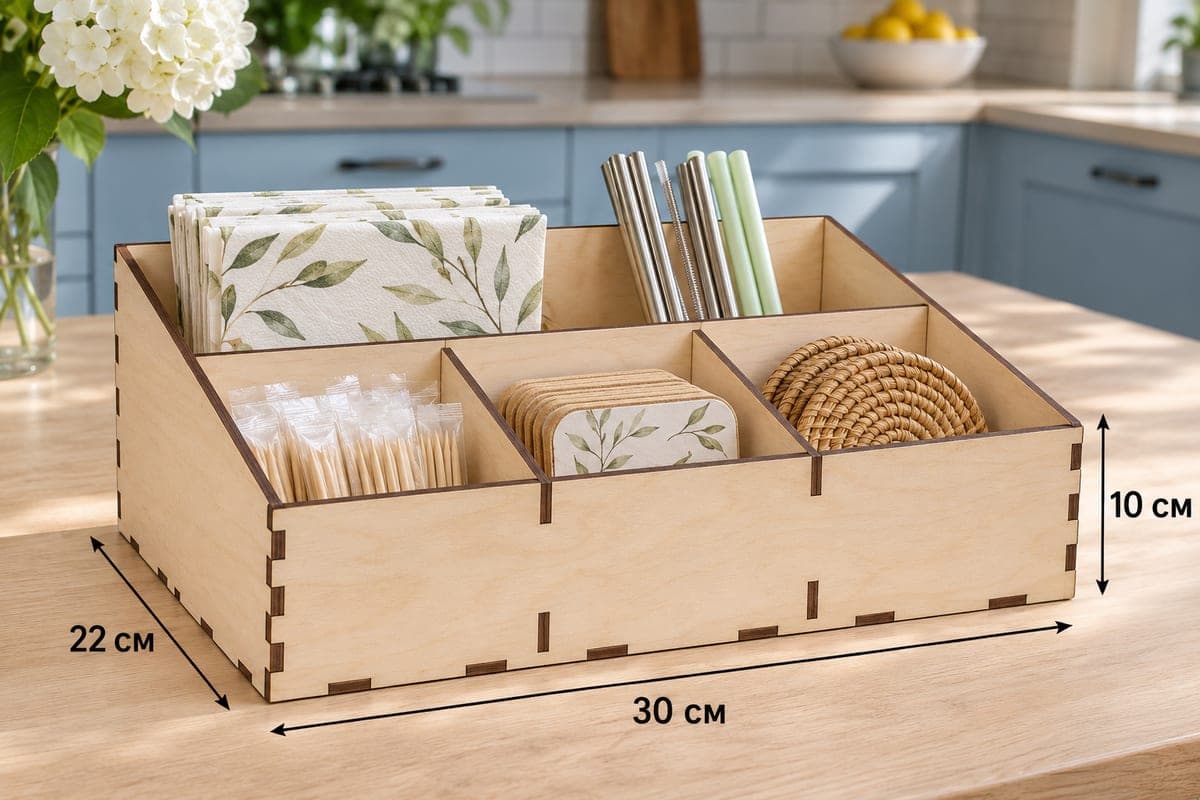
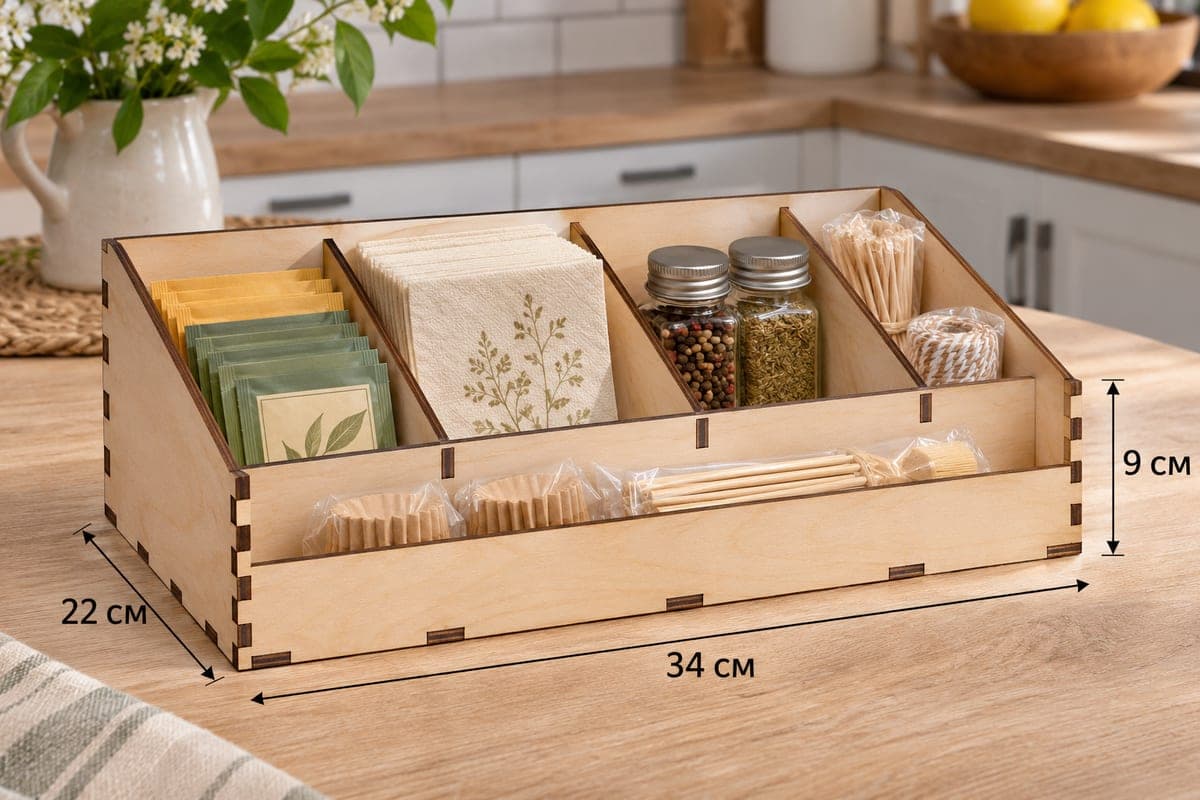
The widest section on the left takes a stack of folded paper napkins standing on edge. The middle one suits a pile of round cork coasters with a small glass of toothpicks in front, and the right section is tall enough for metal or glass drinking straws. The front wall is only 48 mm high while the back stands at 80 mm, so the sides slope down and every napkin can be pulled out without lifting the caddy. Two full-depth dividers run front to back and make the three pockets.
Cutting and assembly notes
Cutting time for the 3 mm file is about 14 min 35 s on a 10 W diode, about 6 min 05 s on a 40 W CO2 and about 2 min 55 s on a 100 W CO2. A 10 W diode handles 3 mm birch in one or two passes; for 5 or 6 mm you need more passes or a stronger tube. The layout is 820 × 252 mm, so on a smaller bed move the base and back to a second sheet.
Start with the base, push the back and both sloped sides into it, then slide the two dividers in and close the box with the low front. The tabs hold well dry. Add a drop of wood glue to each joint if the caddy will be carried around a lot.
Finishing and selling it
Sand the burnt edges lightly and wipe on food-safe oil or a clear water-based lacquer, since napkin caddies get wet rings and crumbs. Sold empty or filled with a set of coasters, it makes a tidy housewarming gift. Cafe owners and wedding planners also buy them in sets of four or six for table service, and a few matching caddies make an easy craft fair bundle.
Questions about this file
Will standard paper dinner napkins fit?
Napkins folded to about 15 cm stand upright in the left section, because the inside depth is just under 160 mm. Larger napkins can be folded once more or laid flat in a stack.
What does the low 48 mm front do on this caddy?
The 48 mm front lets you see and grab napkins and straws from the side of the table. The taller 80 mm back keeps everything from tipping over.
Can I make it bigger for restaurant napkins?
Scale the whole drawing, but redraw the slot width to the real thickness of your plywood afterwards. Scaling also stretches the slots, and then the tabs will wobble.
Is 3 mm plywood strong enough for this caddy?
Yes, 3 mm birch is plenty for napkins and coasters and cuts fastest. Choose 5 or 6 mm if you want a heavier, more rustic look on a cafe counter.
Can I add a name or logo to the front?
The file has cut lines only, but the long front face is a good place for an engraving you add yourself in your laser software before cutting.
Similar files