 Visualization
Napkin and Coaster Caddy SVG, Five Compartment Table Organizer Laser File, Tall Serving Caddy DXF
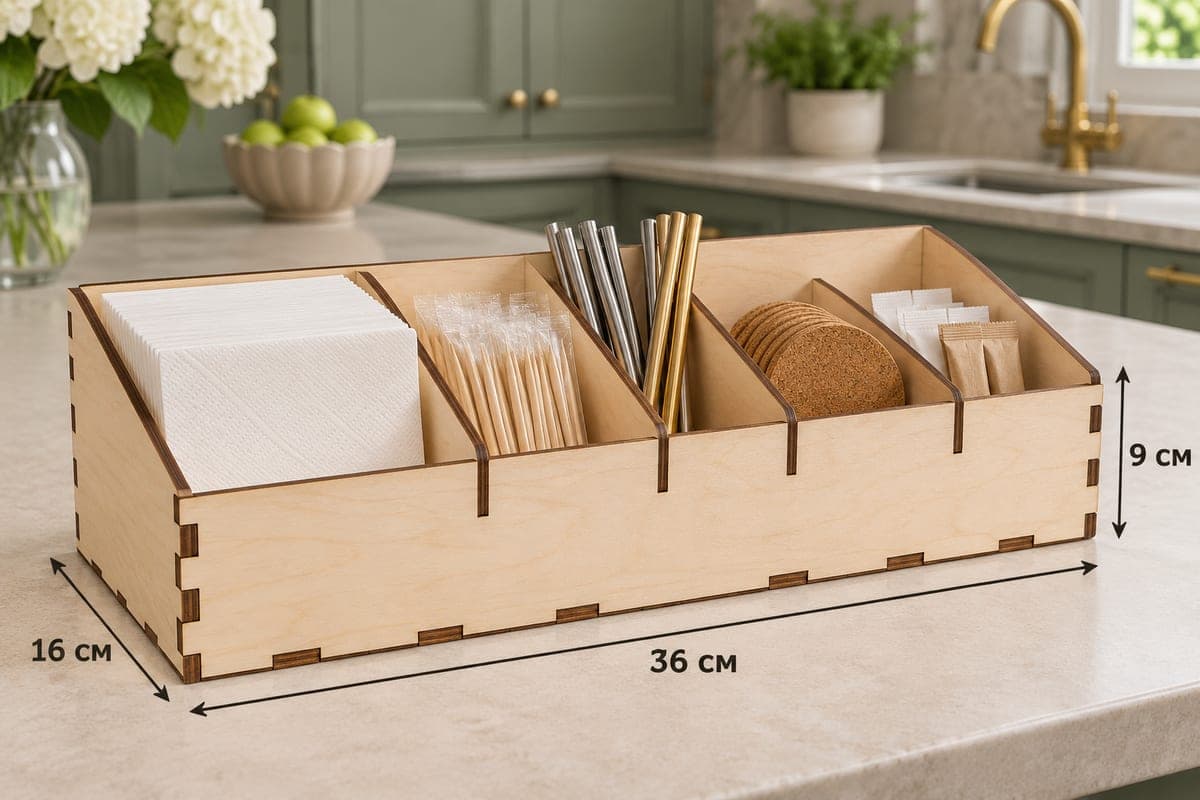
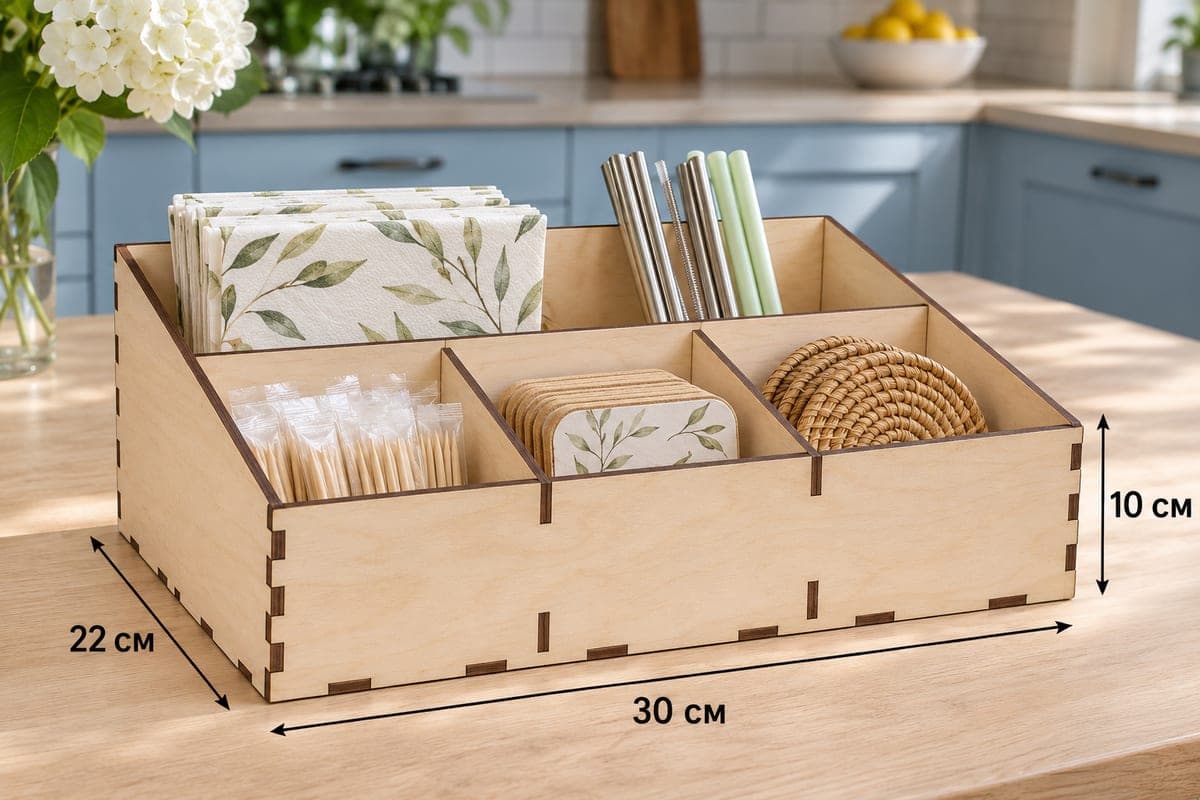
A tall table caddy with five compartments: two back slots for napkins and straws and three front pockets for toothpicks and two kinds of coasters. It is provided as SVG and DXF with separate files for 3, 4, 5 and 6 mm plywood, measures 300 × 220 × 100 mm (11.81 × 8.66 × 3.94 in), is cut from 9 pieces, has a sloped low front, and assembles with tabs and slots. All eight files are free.
- Formats
- SVG, DXF
- Outer size (W × D × H)
- 300 × 220 × 100 mm (11.81 × 8.66 × 3.94 in)
- Parts
- 9
- Material thickness
- 3, 4, 5 or 6 mm plywood (a file for each)
- Layout size (3 mm file)
- 1,060 × 332 mm
- Cut length
- 6.63 m
- Est. time, 10 W diode (3 mm)
- 22 min 06 s
- Est. time, 40 W CO2 (3 mm)
- 9 min 13 s
- Layers
- CUT only, no engraving
Free account required to download
How to make it
- 01Choose the file for your plywood thickness and do a one-slot test cut.
- 02Cut the base, tall back, low front, two sloped sides, the cross divider, the full-height back divider and the two front dividers.
- 03Attach the three dividers to the cross divider, drop the frame into the base, and close it with the sides, back and front.
- 04Sand and seal, then stand napkins and straws in the back slots and put toothpicks and coasters in the front pockets.
Two rows, five compartments
A full-width cross divider separates a back row from a front row. The back row is split once by a full-height divider: one wide slot for napkins standing upright and one narrower slot for straws. Two shorter dividers split the front row into three pockets. The photo fills them with wrapped toothpicks, printed square coasters and round woven coasters, which makes this caddy a natural home for a coaster collection.
The back wall is 100 mm, so standing napkins and long straws stay upright and do not flop. The sides slope to a 60 mm front, which keeps the front pockets easy to reach. The footprint is 300 by 220 mm.
Plywood, cutting and assembly
Five compartments in a 300 mm width means the dividers take up a fair share of the space in thick plywood. For the roomiest pockets use 3 or 4 mm; 5 or 6 mm make a heavier caddy that stays put on a restaurant table.
The 3 mm layout is 1060 × 332 mm. Time for the 3 mm file: about 22 min 06 s on a 10 W diode, about 9 min 13 s on a 40 W CO2, about 4 min 25 s on a 100 W CO2. A diode needs one or two passes on 3 mm and several on thicker plywood.
Slot the two front dividers and the back divider onto the cross divider, set this frame into the base, then add the sides, back and front. The tabs hold without glue. Sand, then seal with clear lacquer or oil.
Selling it as a coaster set
Pair it with a set of your own laser-cut coasters and you have a gift set with a higher price than either piece alone.
Questions about this file
What sizes of coaster fit the front pockets?
Each front pocket is about 95 mm wide, which suits standard 90 mm round or square coasters.
Why does the back row have its own divider?
It keeps straws from leaning into the napkins; the full-height divider runs up to the 100 mm back wall.
Can I engrave a pattern on the sides?
Yes; add any engraving you like in your software, since the file contains only cut lines.
Is plywood safe on a wet patio table?
Sealed plywood copes with the odd spill; use exterior lacquer and bring it in overnight if you leave it outdoors.
Does it work as a tea station?
Yes; the back slots take tea bags or stirrers and the front pockets hold sugar sticks and milk portions.
Similar files