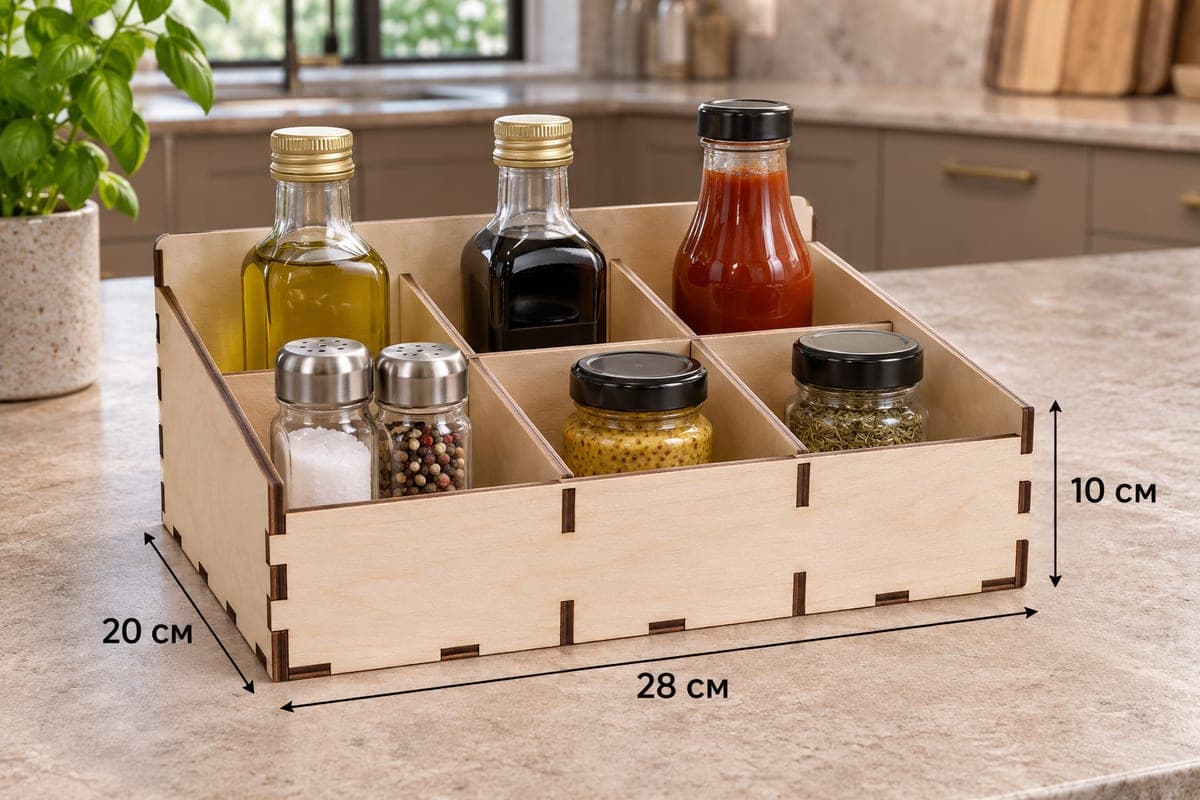
 Visualization
Condiment Organizer SVG, Six Compartment Sauce and Oil Tray Laser Cut File, Sloped Kitchen Bin DXF
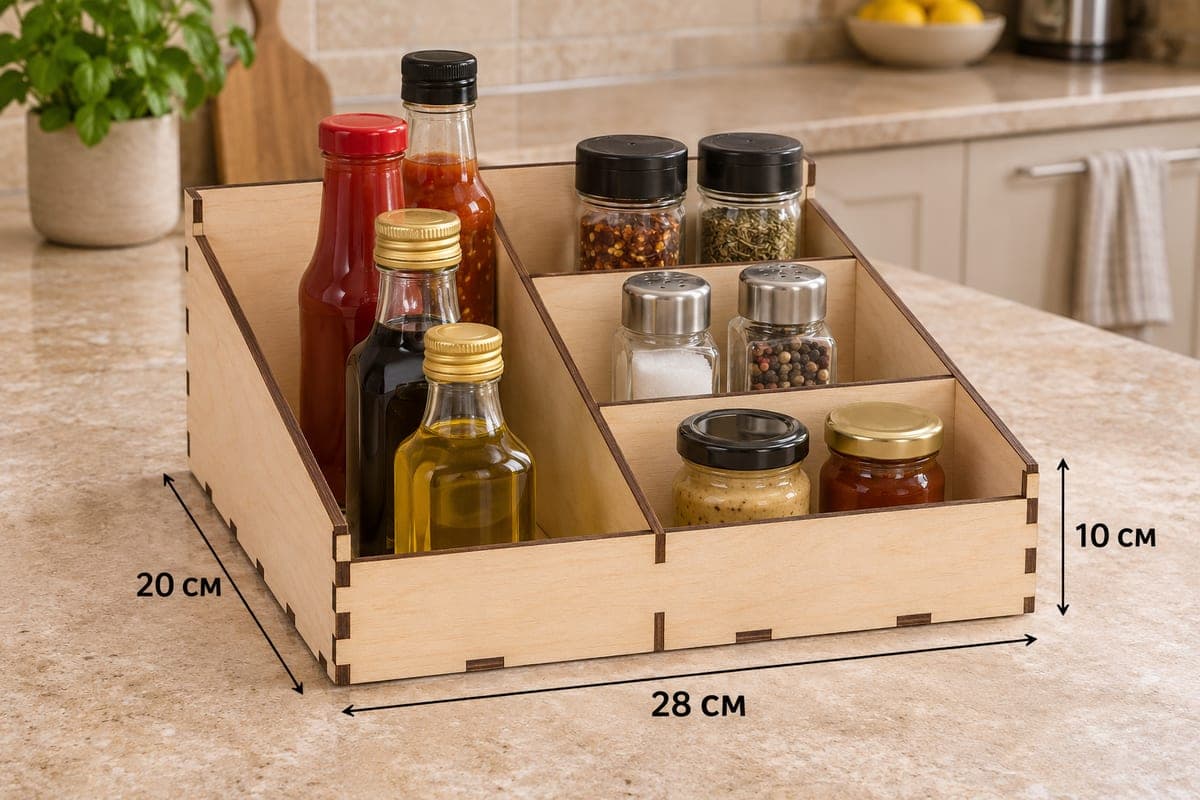
A two-row condiment organizer with six compartments: three tall back bays for oil, vinegar and sauce bottles and three lower front bays for shakers and jars. The download contains SVG and DXF files for 3, 4, 5 and 6 mm plywood; the box is 280 × 200 × 100 mm (11.02 × 7.87 × 3.94 in), has 10 pieces and a sloped front that drops to 60 mm, and fits together with tabs and slots. Free download.
- Formats
- SVG, DXF
- Outer size (W × D × H)
- 280 × 200 × 100 mm (11.02 × 7.87 × 3.94 in)
- Parts
- 10
- Material thickness
- 3, 4, 5 or 6 mm plywood (a file for each)
- Layout size (3 mm file)
- 988 × 312 mm
- Cut length
- 6.58 m
- Est. time, 10 W diode (3 mm)
- 21 min 56 s
- Est. time, 40 W CO2 (3 mm)
- 9 min 08 s
- Layers
- CUT only, no engraving
Free account required to download
How to make it
- 01Choose the file set for your sheet (3, 4, 5 or 6 mm) and cut a single slot on an offcut to confirm the fit before the full run.
- 02Cut the ten parts, keeping the two short front dividers apart from the two taller back dividers so they do not get mixed up.
- 03Assemble base, back, sides and front, set the long cross divider in place, then slide the short dividers in front of it and the tall ones behind it.
- 04Sand, seal with lacquer or oil, and place bottles in the back row and shakers and jars in the front row.
How the six bays are arranged
One long cross divider runs the full 280 mm width and splits the box into a back row and a front row, and each row is cut into three bays. The back bays are full 100 mm height and hold the tall bottles: in the photo an olive oil, a balsamic vinegar and a ketchup bottle. The front bays sit behind a lower cross divider, so short items are visible at a glance: a salt and pepper pair, a mustard jar and a jar of dried herbs.
The sides slope from 100 mm at the back to 60 mm at the front. That step-down is what makes this layout work on a counter: you see every label without lifting anything.
Cutting notes
There are 10 parts: front, back, two sides, base, the cross divider, two short dividers for the front row and two taller ones for the back row. The 3 mm layout is 988 × 312 mm, so most diode lasers need the parts split across two or three smaller sheets. Estimated time for the 3 mm file is about 21 min 56 s on a 10 W diode, about 9 min 08 s on a 40 W CO2 and about 4 min 23 s on a 100 W CO2. Thicker 5 and 6 mm stock needs more passes or more power.
Finishing for kitchen use
Tab-and-slot joints hold without glue, but a drop of wood glue on the base tabs stops the box from loosening when you slide it across the counter. Sand the cut edges lightly, then seal with a clear lacquer or a hard wax oil so drips from bottles wipe off.
As a gift, pair it with a bottle of good olive oil and homemade spice blends. Small cafes also buy these for table condiments.
Questions about this file
What sizes fit in the front compartments?
Each front bay is roughly 90 mm wide and suits two standard spice shakers or one 200 ml jar. The back bays take bottles up to about 90 mm across.
Which thickness should I cut for heavy glass bottles?
Use 4 or 5 mm plywood for a box loaded with glass; 3 mm is lighter and fine for plastic bottles and shakers.
Can I cut it from clear acrylic?
Yes, use the file whose thickness matches your acrylic. Acrylic tabs do not compress like wood, so check the test slot carefully and glue with acrylic cement.
Do I need to glue the dividers?
No, the dividers sit firmly in their slots. Glue them only if you want the layout permanent.
Can I scale the organizer to fit a cabinet shelf?
You can scale the outline, but the slot width must stay equal to your material thickness, so adjust slots separately after resizing.
Similar files