 Visualization
Four Pocket Table Caddy SVG, Napkin and Coaster Organizer Laser File, Stepped Grid Caddy DXF
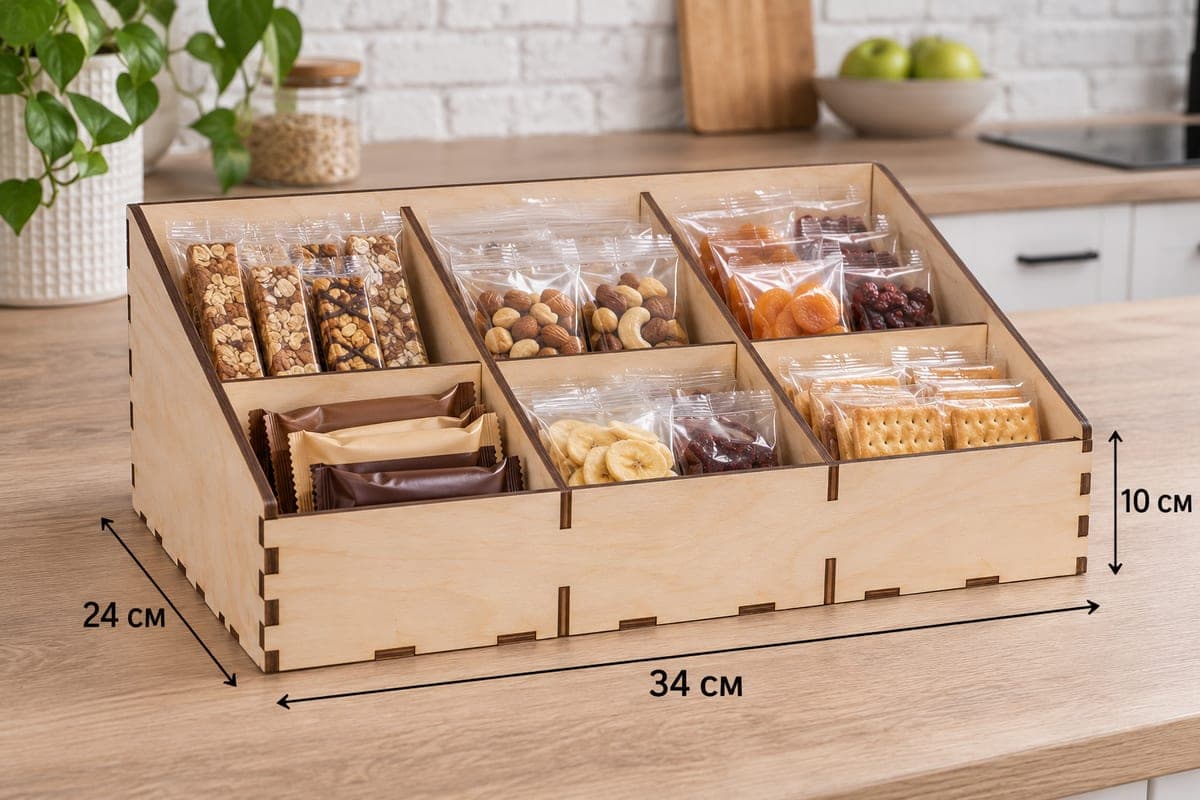
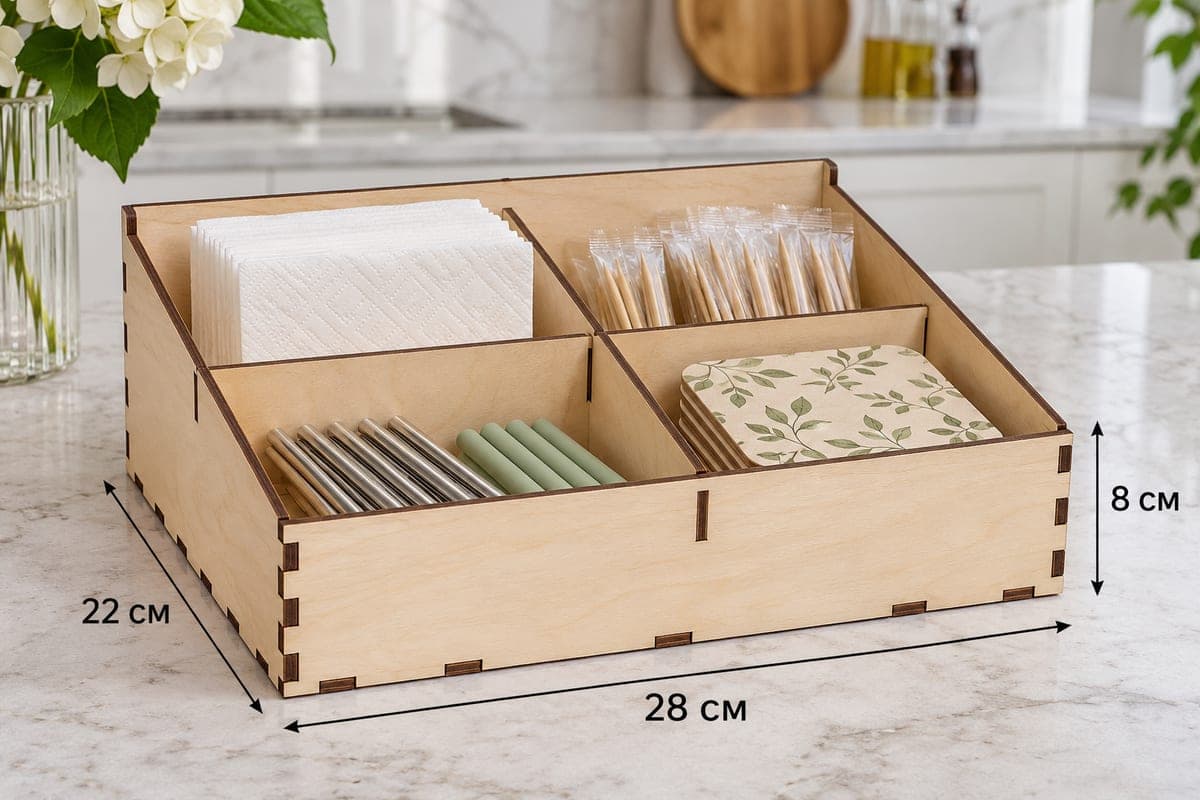
A low table caddy with four pockets in a two-by-two grid, the back row taller than the front, for napkins, toothpicks, straws and coasters. It comes as SVG and DXF with separate files for 3, 4, 5 and 6 mm plywood, measures 280 × 220 × 80 mm (11.02 × 8.66 × 3.15 in), has 8 pieces, a sloped low front and tab-and-slot joints. Free to download.
- Formats
- SVG, DXF
- Outer size (W × D × H)
- 280 × 220 × 80 mm (11.02 × 8.66 × 3.15 in)
- Parts
- 8
- Material thickness
- 3, 4, 5 or 6 mm plywood (a file for each)
- Layout size (3 mm file)
- 1,020 × 312 mm
- Cut length
- 5.60 m
- Est. time, 10 W diode (3 mm)
- 18 min 40 s
- Est. time, 40 W CO2 (3 mm)
- 7 min 47 s
- Layers
- CUT only, no engraving
Free account required to download
How to make it
- 01Choose the 3, 4, 5 or 6 mm file and test one slot; label the two short dividers because one is taller.
- 02Cut the base, back, low front, two sloped sides, the cross divider and both short dividers.
- 03Put the taller short divider behind the cross divider and the lower one in front, set the frame in the base, then close the box with the walls.
- 04Sand and seal, then fill the back pockets with napkins and toothpicks and the front pockets with straws and coasters.
A two-by-two grid
A cross divider runs the full width and splits the caddy into a back row and a front row, and each row is halved by its own short divider. That gives four pockets of roughly equal size. The back row is taller, because its divider reaches the full 80 mm, while the front divider is lower; the front wall is just 44 mm. In the photo the back holds folded napkins and wrapped toothpicks, and the front holds metal and silicone straws lying down next to a stack of printed square coasters.
At 80 mm tall this is one of the lowest caddies in the napkin set, so it does not block anyone's view across the table. The 280 by 220 mm footprint suits a small round dining table or a balcony bistro set.
Cutting and the two divider heights
The 3 mm layout is 1020 × 312 mm. For the 3 mm file allow about 18 min 40 s on a 10 W diode, about 7 min 47 s on a 40 W CO2, about 3 min 44 s on a 100 W CO2. A 10 W diode cuts 3 mm in one or two passes; 5 and 6 mm need several. On a smaller bed put the base on its own sheet.
The two short dividers have different heights: the taller one goes in the back row. Slot both onto the cross divider, drop the frame into the base, then add the sides, back and front. Sand all edges, then finish with oil or lacquer.
A hostess gift idea
Fill it with seasonal napkins and matching coasters and give it as a hostess gift; the grid layout makes a tidy photo for a shop listing too.
Questions about this file
How big are the four pockets?
Each is roughly 135 by 105 mm inside, enough for folded cocktail napkins, a stack of coasters or a bundle of straws lying flat.
Why is the back row taller?
Napkins standing in the back stay visible behind the lower front pockets, and the 44 mm front keeps the caddy easy to reach into.
Which plywood thickness works best?
3 or 4 mm for a light table piece; 5 or 6 mm if it will be used every day in a cafe.
Can I glue it?
You can, but it is not necessary; a small drop of wood glue per joint only helps if the caddy gets carried around a lot.
Can I cut matching coasters on the same sheet?
Yes, if there is leftover space on your sheet, add simple 90 mm squares or circles; they fit the front pockets.
Similar files