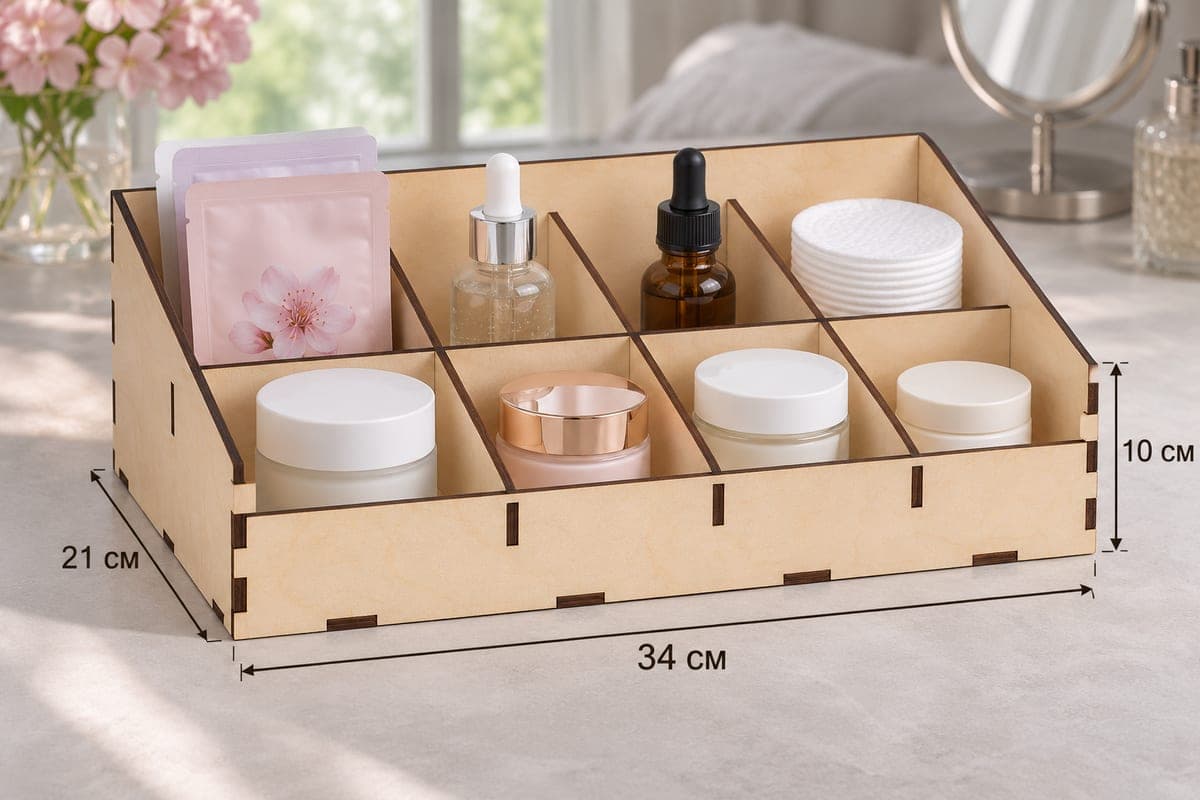
 Visualization
Eight Compartment Skincare Organizer SVG, Grid Vanity Tray Laser Cut File, Cosmetic Jar Storage Box DXF
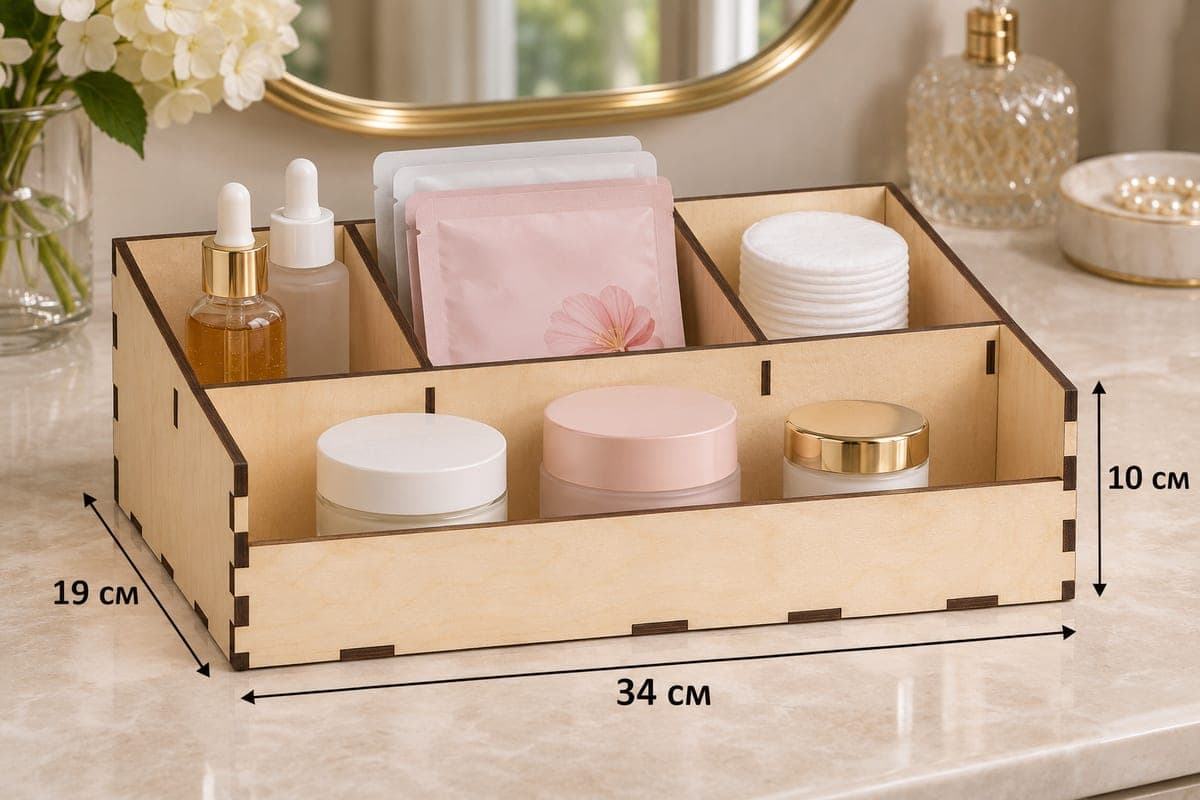
An eight-compartment skincare organizer laid out as four columns in two rows, available as SVG and DXF with separate files for 3, 4, 5 and 6 mm plywood. Outer size is 340 × 210 × 100 mm (13.39 × 8.27 × 3.94 in), it has 12 pieces, and the sides slope from the back to a 55 mm front. Tabs and slots hold every joint, and the files are free to download.
- Formats
- SVG, DXF
- Outer size (W × D × H)
- 340 × 210 × 100 mm (13.39 × 8.27 × 3.94 in)
- Parts
- 12
- Material thickness
- 3, 4, 5 or 6 mm plywood (a file for each)
- Layout size (3 mm file)
- 1,346 × 322 mm
- Cut length
- 8.34 m
- Est. time, 10 W diode (3 mm)
- 27 min 49 s
- Est. time, 40 W CO2 (3 mm)
- 11 min 35 s
- Layers
- CUT only, no engraving
Free account required to download
How to make it
- 01Choose the SVG or DXF for your plywood thickness, split the 1346 mm layout across sheets if your bed is smaller, and test one slot.
- 02Cut all 12 parts: front, back, two sloped sides, base, three long dividers and four short cross dividers.
- 03Set the three long dividers in the base, add one cross divider to each column, then fit the back, the sides and the low front.
- 04Sand, lacquer, and assign one product to each of the eight compartments.
A grid of eight
Three full-depth dividers split this organizer into four columns, and four short cross dividers, one per column, break each column into a back cell and a front cell. The result is a neat grid of eight compartments, the most of any 340 mm box in this set.
The photo shows a bedroom vanity version: sheet masks, a clear serum, an amber serum and cotton pads across the back row, and four cream jars of different sizes along the front, one per cell. Eight cells suit a collection where every product has a fixed place, so a quick glance shows what is running low.
Laser bed and cutting time
Twelve parts make a longer layout: the 3 mm file is 1346 × 322 mm. Few hobby lasers take that in one go, so plan to split it across two or three sheets, for example the base and back on one, the sides and long dividers on another, and the small cross dividers in the gaps. Cutting the 3 mm file takes about 27 min 49 s on a 10 W diode, about 11 min 35 s on a 40 W CO2 and about 5 min 34 s on a 100 W CO2. With 5 or 6 mm stock a diode needs several passes.
Assembly order
Stand the three long dividers in the base first. Then drop the four short cross dividers into their slots, one per column, and check they sit square. Add the back, the two sloped sides and the front last. The joints hold without glue; a drop of wood glue in each cross divider slot makes the grid rigid.
Finish with clear lacquer so jar rings wipe off. For selling, a top-down photo of all eight cells filled tells buyers more than any description.
Questions about this file
How many products does it hold?
Eight compartments, four along the back for taller items such as serums and masks and four in front for cream jars.
My laser bed is small. Can I still cut it?
Yes. Move the parts onto two or three sheets in your laser software; the pieces are independent and only need to keep their shape and slot sizes.
Can I scale it down for a drawer?
You can shrink the outline, but slots must be reset to your sheet thickness afterwards or the dividers will not fit.
Which material is best: plywood, MDF or acrylic?
Birch plywood is the easiest and strongest. MDF cuts cleanly but needs sealing, and acrylic works if you use the file for its thickness.
Should I glue the short cross dividers?
They hold in their slots on their own, but a drop of wood glue in each keeps the grid from shifting when you lift out a jar.
Similar files