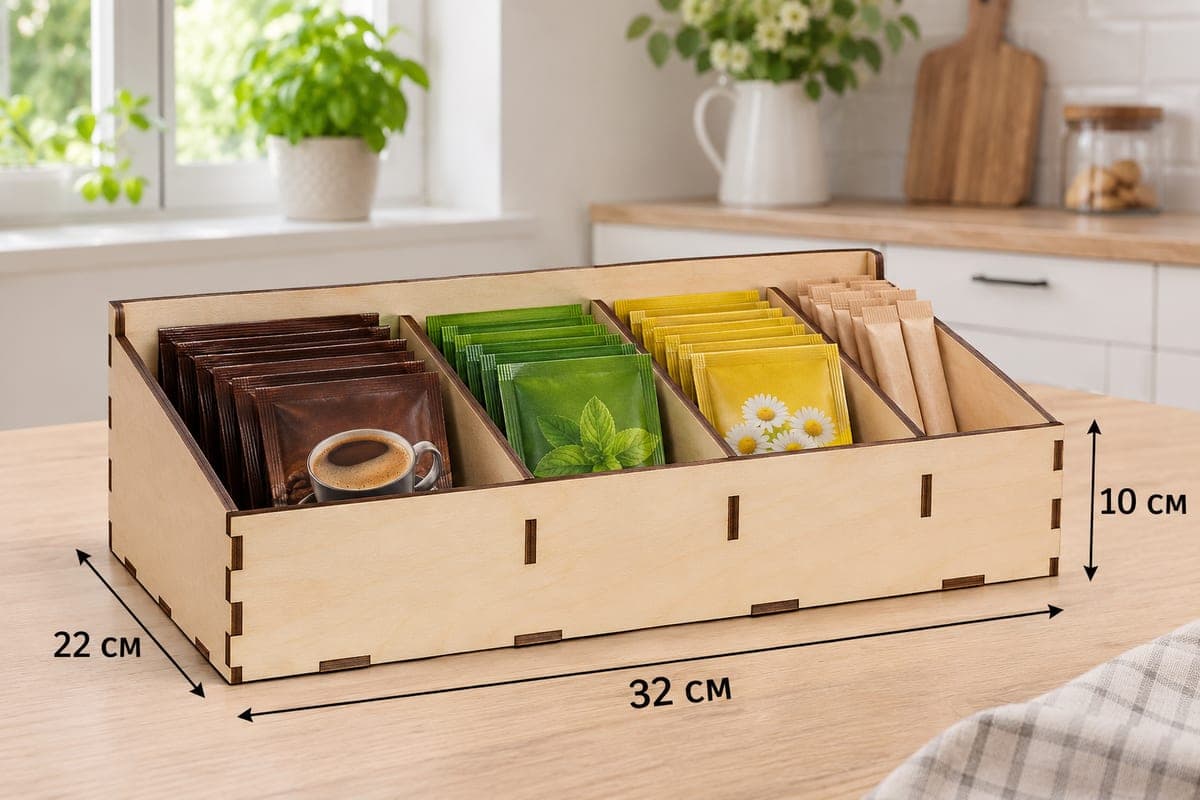
 Visualization
Tall Tea Bag Holder SVG, Four Lane Tea Box Laser Cut File, Deep Wooden Tea Organizer DXF, Tea Bag Filing Box for Counter
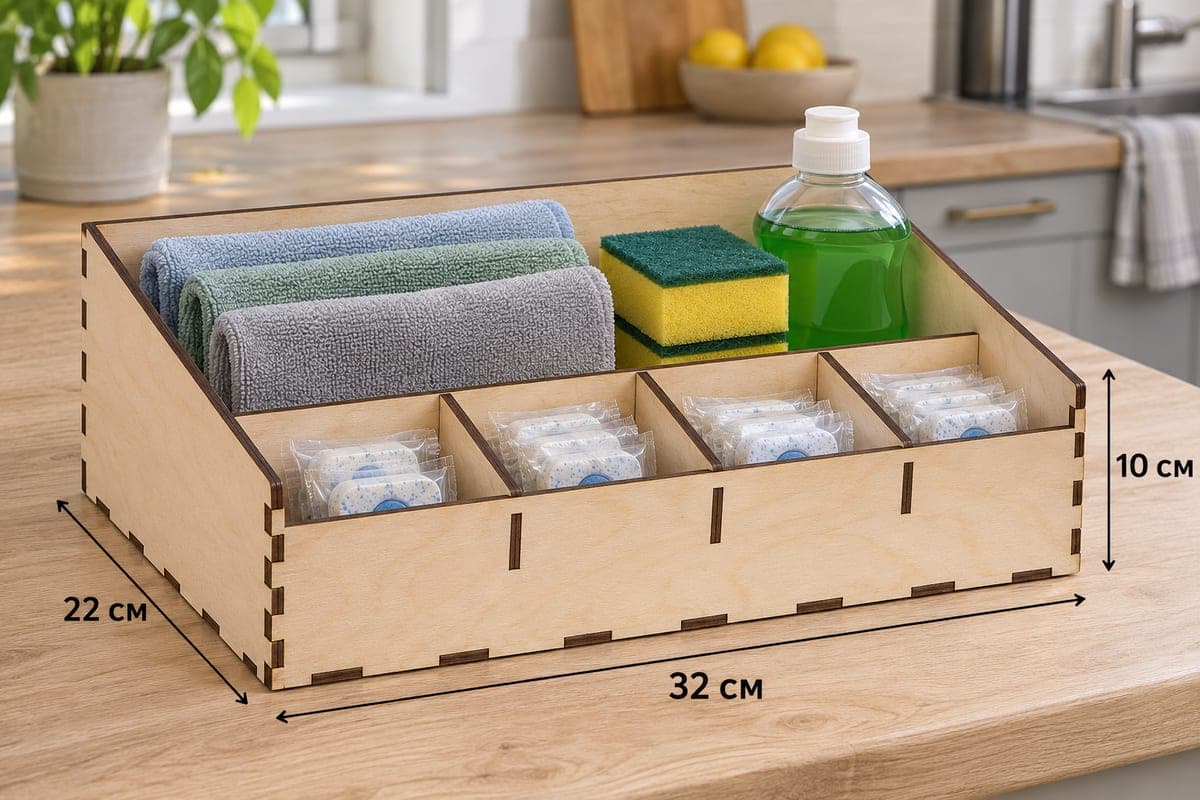
A tall, deep tea bag holder with four lanes that run from front to back, so tea bags and coffee sachets stand in long rows like files in a drawer. It is a free download of SVG and DXF files drawn for 3, 4, 5 and 6 mm plywood; the box measures 320 × 220 × 100 mm (12.60 × 8.66 × 3.94 in), uses 8 pieces with tab-and-slot joints, and has sides sloping from a 100 mm back to a 60 mm front.
- Formats
- SVG, DXF
- Outer size (W × D × H)
- 320 × 220 × 100 mm (12.60 × 8.66 × 3.94 in)
- Parts
- 8
- Material thickness
- 3, 4, 5 or 6 mm plywood (a file for each)
- Layout size (3 mm file)
- 1,100 × 332 mm
- Cut length
- 6.65 m
- Est. time, 10 W diode (3 mm)
- 22 min 11 s
- Est. time, 40 W CO2 (3 mm)
- 9 min 14 s
- Layers
- CUT only, no engraving
Free account required to download
How to make it
- 01Open the SVG or DXF for your plywood thickness and test one slot so the tall dividers stand straight.
- 02Cut the eight parts, including three identical 220 × 100 mm dividers.
- 03Slot the three dividers into the base, add the 100 mm back and both sloped sides, then fit the 60 mm front.
- 04Sand, seal and file one flavour of tea bags or sachets along each of the four lanes.
Long lanes for big stocks
If you buy tea in boxes of 50 or 100, a grid of small cells fills up after one pack. This holder takes the opposite approach: three dividers, each the full 220 mm deep and 100 mm tall, give four long lanes with no cross pieces. Each lane holds a long row of envelopes, one flavour per lane, and you simply take from the front.
In the photo the lanes hold coffee sachets, mint tea, chamomile and a row of tall sugar and creamer sticks. With a 100 mm back wall it shares the top height in the tea set, and the high walls keep a long row upright even when it is half empty.
The 60 mm front is low enough to read the first envelope in each lane and to slip your fingers in.
Cutting and assembly
Eight pieces only: base, back, front, two sloped sides and three identical dividers. The 3 mm layout is 1100 × 332 mm; split it over two sheets if your bed is about 600 mm wide, three if it is smaller. Times for the 3 mm file: a 10 W diode about 22 min 11 s, a 40 W CO2 about 9 min 14 s, a 100 W CO2 about 4 min 26 s. Thick 5–6 mm sheets suit a CO2 laser; on a 10 W diode keep to 3 mm, which it cuts in one or two passes.
Because the dividers are identical you cannot mix them up. Slot them into the base, then add the back and sides; the front goes on last. Glue under each divider is optional but helps the lanes stay parallel.
Make it a set
Pair it with the small three-slot tea box for a second room or an office. For selling, a tall four-lane box photographs well with four colours of tea bags, and a dark-stained version suits a coffee bar shelf. Finish with clear lacquer or a food-safe oil.
Questions about this file
How many tea bags fit in one lane?
Each lane runs the full 220 mm depth, so it takes a long row of envelopes; the count depends on how thick your brand's envelopes are.
Can I split a lane into two?
There are no cross dividers in this file, but a loose offcut dropped across a lane works as a simple separator.
Will it fit in a cupboard?
Check for at least 100 mm of clear height plus the height of your sachets; most standard shelves have plenty.
Is acrylic a good alternative?
Frosted 3 mm acrylic looks neat in a modern kitchen; use the 3 mm file on a CO2 laser and bond it with acrylic cement.
Is 3 mm or 4 mm better for the tall walls?
3 mm works, but the tall walls feel firmer in 4 mm, which is still a light job for a 40 W CO2.
Similar files