 Visualization
Kitchen Drawer Organizer SVG, 8 Compartment Food Bag Tray Laser Cut File, Low Gadget Sorter Box DXF
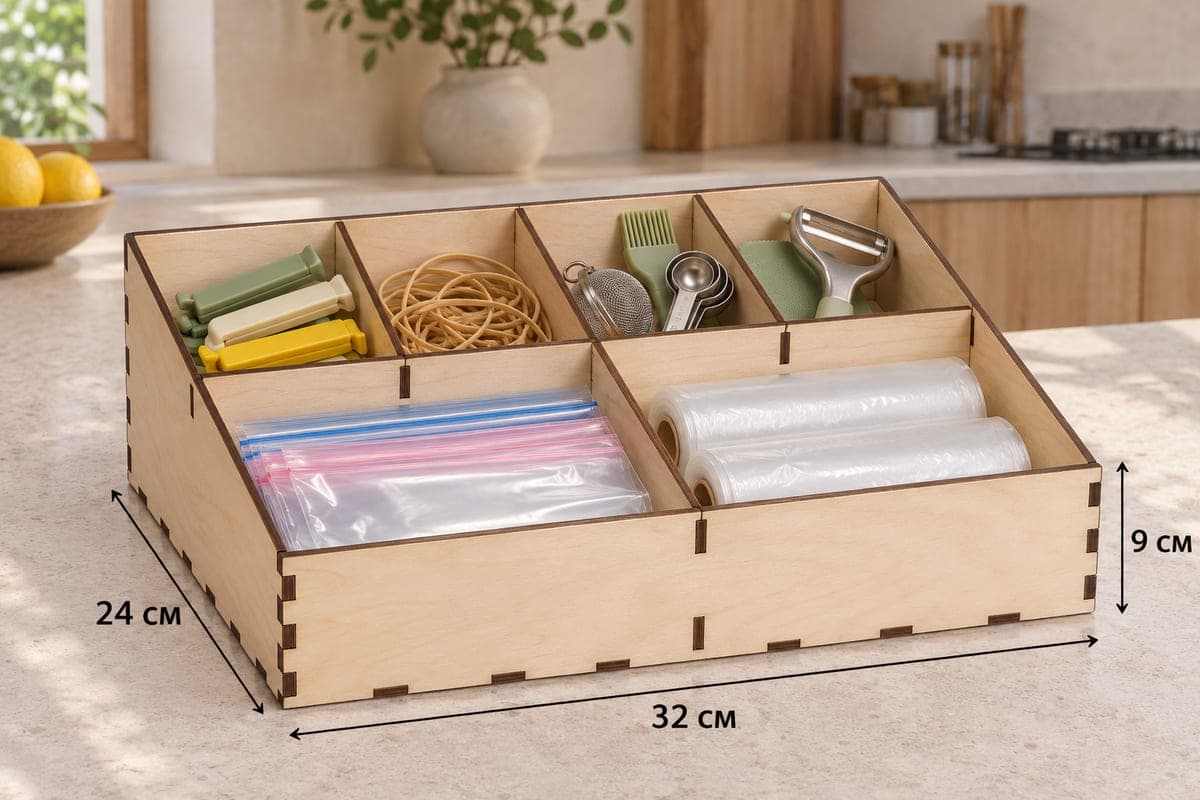
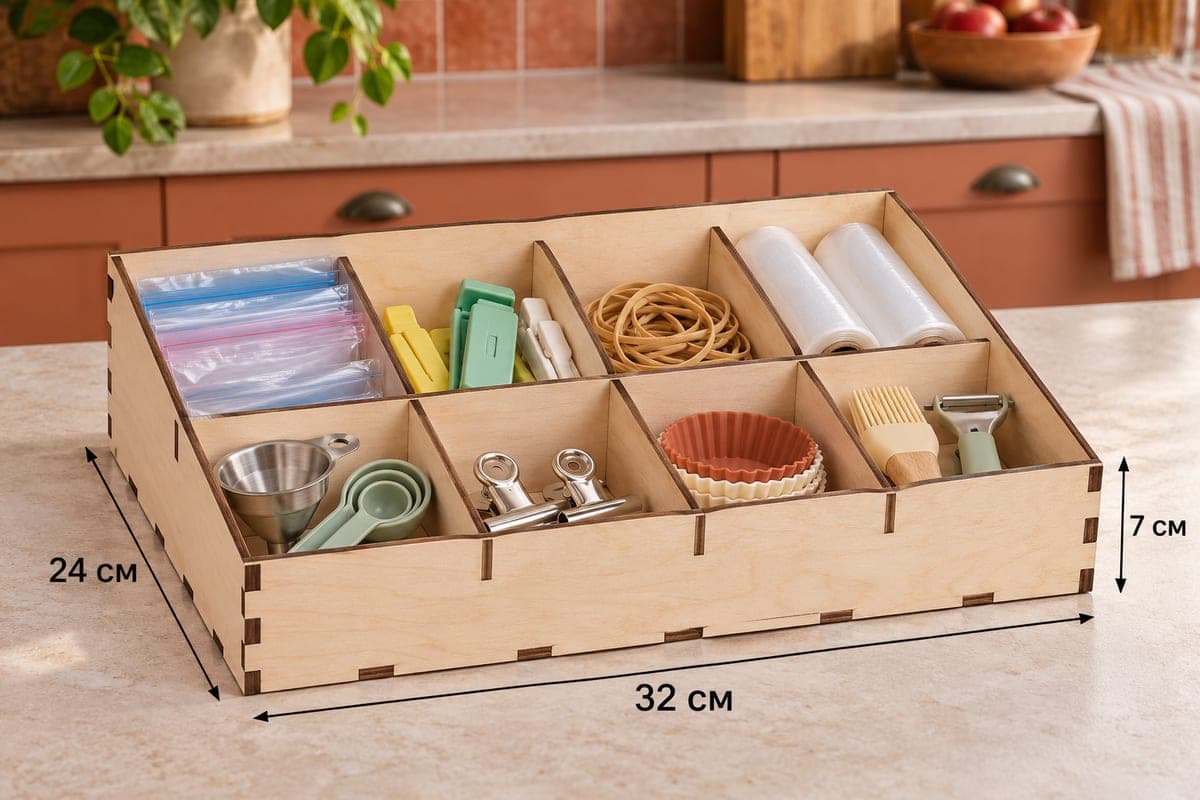
A low kitchen tray with 8 cells in two rows of four for zip bags, wrap, clips, baking cups and small tools. It comes as SVG and DXF with separate files for 3, 4, 5 and 6 mm plywood, measures 320 × 240 × 70 mm (12.60 × 9.45 × 2.76 in) and is cut from 12 pieces. The back wall is 70 mm and the sides slope to a 38 mm front; it assembles with tabs and slots and is a free download.
- Formats
- SVG, DXF
- Outer size (W × D × H)
- 320 × 240 × 70 mm (12.60 × 9.45 × 2.76 in)
- Parts
- 12
- Material thickness
- 3, 4, 5 or 6 mm plywood (a file for each)
- Layout size (3 mm file)
- 1,274 × 396 mm
- Cut length
- 7.84 m
- Est. time, 10 W diode (3 mm)
- 26 min 08 s
- Est. time, 40 W CO2 (3 mm)
- 10 min 53 s
- Layers
- CUT only, no engraving
Free account required to download
How to make it
- 01Pick the version for your plywood (3, 4, 5 or 6 mm) and test-cut one short front divider in a scrap slot.
- 02Cut all twelve parts, sorting the six dividers into the taller back set and the shorter front set.
- 03Assemble base, sides and back, add the cross divider, slot in the three back dividers, then the three front dividers, and close with the 38 mm front.
- 04Sand, oil, and assign one item to each of the eight cells, bags and wrap in the back, small tools in front.
Eight cells, low profile
This is the lowest and most divided box in the food bag set. One cross divider splits the base into two rows, and three dividers in each row make four cells, eight in total, each a little under 80 mm wide. At only 70 mm high it can sit on a counter or go into a deep kitchen drawer. In the photo the back row holds zip bags, sealing clips, rubber bands and two short wrap rolls; the front row takes nested measuring cups and spoons, binder clips, silicone baking cups, and a pastry brush with a peeler.
Cutting twelve parts
Twelve parts means the longest cut in this group: the 3 mm layout is about 1274 × 396 mm. A 10 W diode needs about 26 min 08 s for the 3 mm file, a 40 W CO2 about 10 min 53 s, and a 100 W CO2 about 5 min 14 s. The six small dividers come in two heights, about 54 mm for the front row and 70 mm for the back, so keep them in separate piles as they come off the bed. On a small machine, cut the base alone and the rest on two further sheets. Keep a diode on 3 or 4 mm; the 5 and 6 mm files need more power or extra passes.
Build the shell, insert the cross divider, add the three tall back dividers, then the three short front ones, and fit the 38 mm front. No glue is required, though a drop at each joint makes the grid rigid.
Finishing and gift ideas
Sand every cell edge, since fingers reach into them constantly, and finish with oil. Filled with silicone cupcake cups and clips, it doubles as a baking tool tray, and it suits buyers who prefer clear counters and want a drawer insert.
Questions about this file
Will it fit inside a drawer?
At 70 mm high it fits drawers with at least 75 mm of inside clearance. Measure first, as the footprint is 320 × 240 mm.
Can I make the cells bigger?
Scale the box outline up in your editor but keep the slots and tabs at your real plywood thickness, or the dividers will rattle or not go in.
Which thickness is best for eight small cells?
3 mm keeps the cells roomy and cuts fastest; 6 mm walls take noticeable space out of each cell.
Does the grid shift without glue?
The dividers hold dry, but a drop of glue at each cross-divider joint stops the grid moving when the tray goes in and out of a drawer.
Can it hold baking tools instead of bags?
Yes, the cells suit silicone cupcake cups, cookie cutters, piping tips and measuring spoons just as well as bags and clips.
Similar files