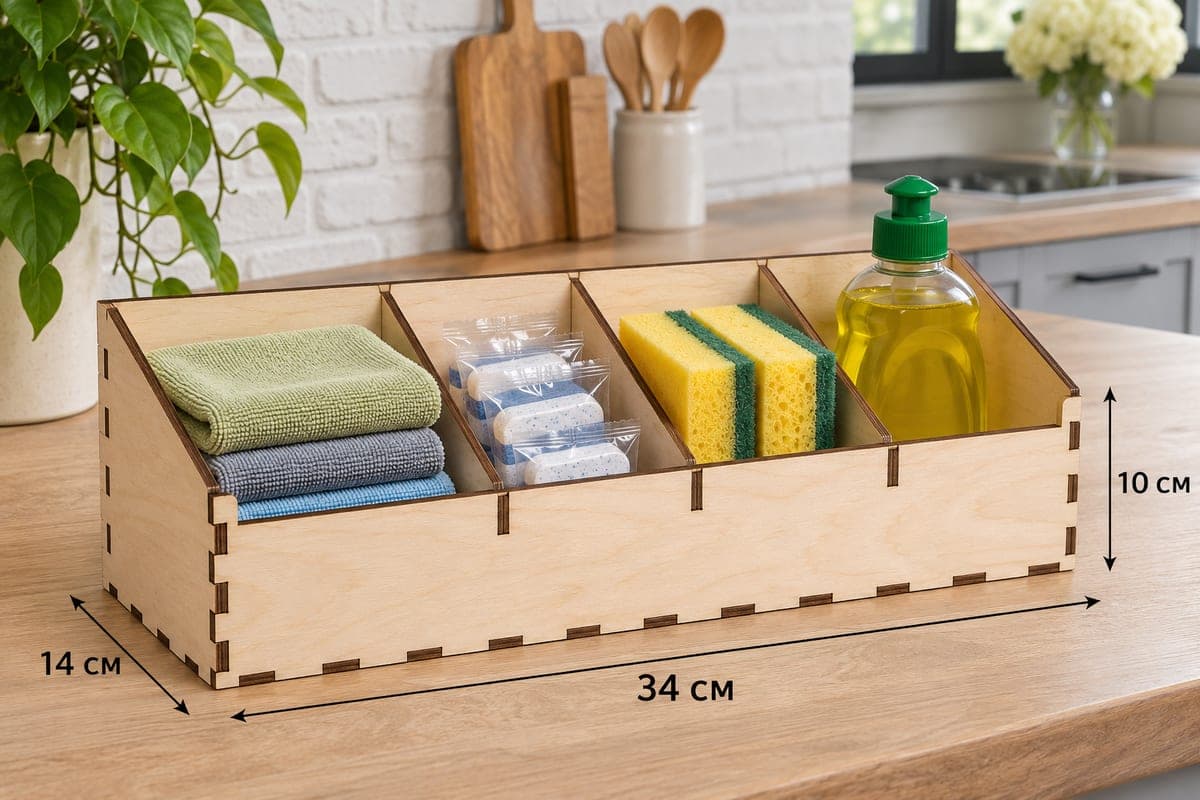
 Visualization
Narrow Sink Organizer SVG, Four Slot Sponge Holder DXF, Slim Dish Soap Caddy Laser Cut File, Windowsill Caddy
This laser cut file makes a narrow sponge organizer only 140 mm deep, with four slots in a single row for cloths, dishwasher tablets, sponges and dish soap, and a sloped front. It contains SVG and DXF files for 3, 4, 5 and 6 mm plywood, an outer size of 340 × 140 × 100 mm (13.39 × 5.51 × 3.94 in) and 8 tab-and-slot pieces. Both formats for all four thicknesses download for free.
- Formats
- SVG, DXF
- Outer size (W × D × H)
- 340 × 140 × 100 mm (13.39 × 5.51 × 3.94 in)
- Parts
- 8
- Material thickness
- 3, 4, 5 or 6 mm plywood (a file for each)
- Layout size (3 mm file)
- 1,324 × 252 mm
- Cut length
- 5.59 m
- Est. time, 10 W diode (3 mm)
- 18 min 37 s
- Est. time, 40 W CO2 (3 mm)
- 7 min 46 s
- Layers
- CUT only, no engraving
Free account required to download
How to make it
- 01Download the version for your plywood thickness and cut one slot on scrap to make sure the tabs fit tightly.
- 02Cut the eight pieces, splitting the long layout over two sheets if needed: front, back, two short sloped sides, base and three dividers.
- 03Slot the three dividers into the base, then fit the back, both sides and the front around them.
- 04Sand, seal against water, and load the slots with cloths, tablets, sponges and soap in whatever order suits your sink.
Slim enough for the sink ledge
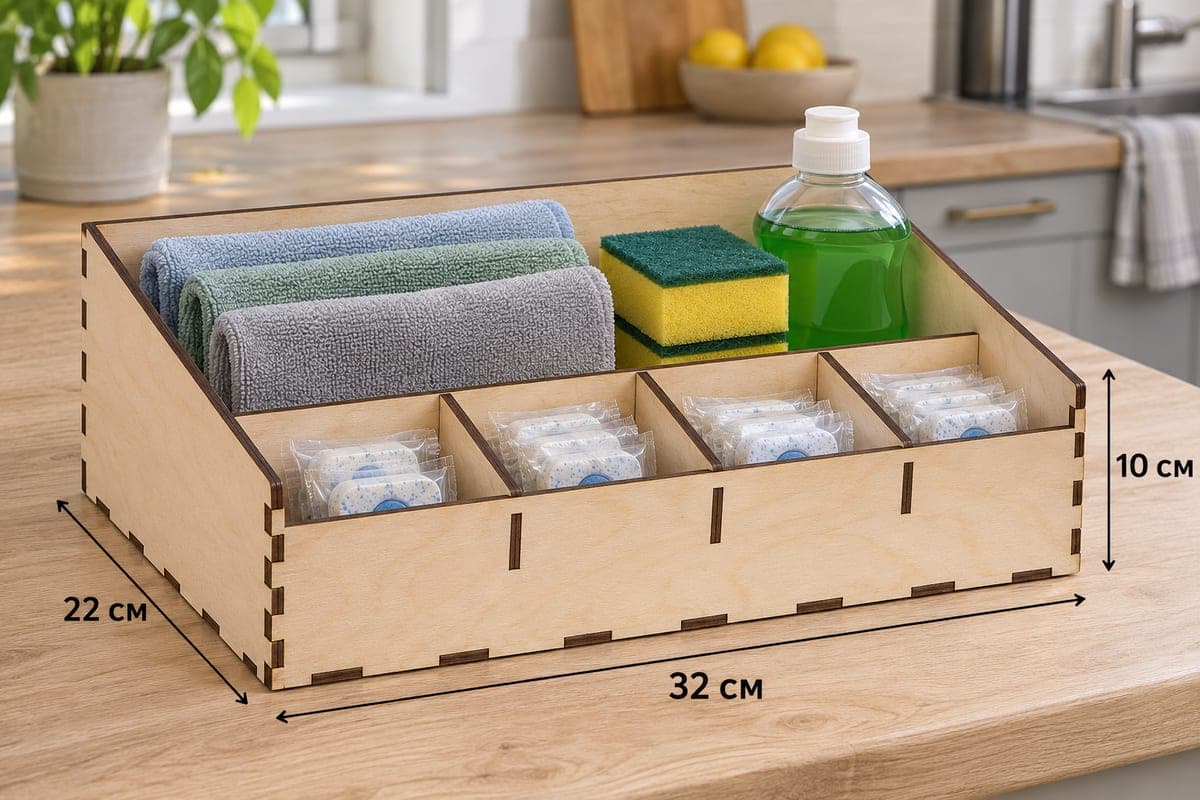
Just 140 mm deep, this organizer fits a narrow ledge behind the faucet, a windowsill above the sink, or a slim shelf. Three dividers run from back to front and split it into four slots in one row, each the full depth of the box. In the photo they hold, from left to right, folded cloths, wrapped dishwasher tablets, two scrub sponges standing on edge, and a dish soap bottle. The front wall is 50 mm against a 100 mm back, so everything leans slightly back and stays visible.
Cutting a long, thin layout
The 3 mm file takes about 18 min 37 s on a 10 W diode, about 7 min 46 s on a 40 W CO2 and about 3 min 43 s on a 100 W CO2, for the 3 mm file. The layout is long and thin: 1324 × 252 mm. Few hobby beds are that long, so plan to move the 340 mm front, back and base onto a second sheet. On a 10 W diode, 3 mm plywood goes through in one or two passes; for 5–6 mm use a CO2 or several passes.
Finishing for daily splashes
A ledge behind the faucet is about the wettest spot in the kitchen. Sand every edge, then seal the organizer with a waterproof lacquer or a hard wax oil, paying attention to the base and the bottom of each slot. The three identical dividers lock in without glue; add wood glue if you want it permanent.
Gift and selling ideas: offer it as a windowsill sink organizer for small kitchens, sell it alongside a matching narrow bathroom shelf caddy, or include it in a set for RV and camper kitchens.
Questions about this file
How deep a ledge does it need?
The base is 140 mm deep, so the ledge or sill should be at least that. The length is 340 mm.
Can I make it longer to fit a wider window?
Lengthening it means redrawing the front, back and base and adding a divider, keeping every slot equal to your plywood thickness. Simple scaling will throw the joints off.
Is 3 mm plywood strong enough?
Yes, for sponges and a soap bottle 3 mm birch plywood is plenty. Use 4 mm if you want stiffer long walls.
Does it need a waterproof finish?
Yes. Behind a faucet it will get wet daily, so seal every surface with polyurethane, spar varnish or oil.
How should I glue a long, narrow box like this?
Glue is optional, but a bead of wood glue in the base slots keeps the 340 mm walls straight. Wipe off any squeeze-out before sealing.
Similar files