 Visualization
Ice Crystal Snowflake SVG, Hexagon Tip Snowflake Laser File DXF, Science Teacher Winter Gift Ornament
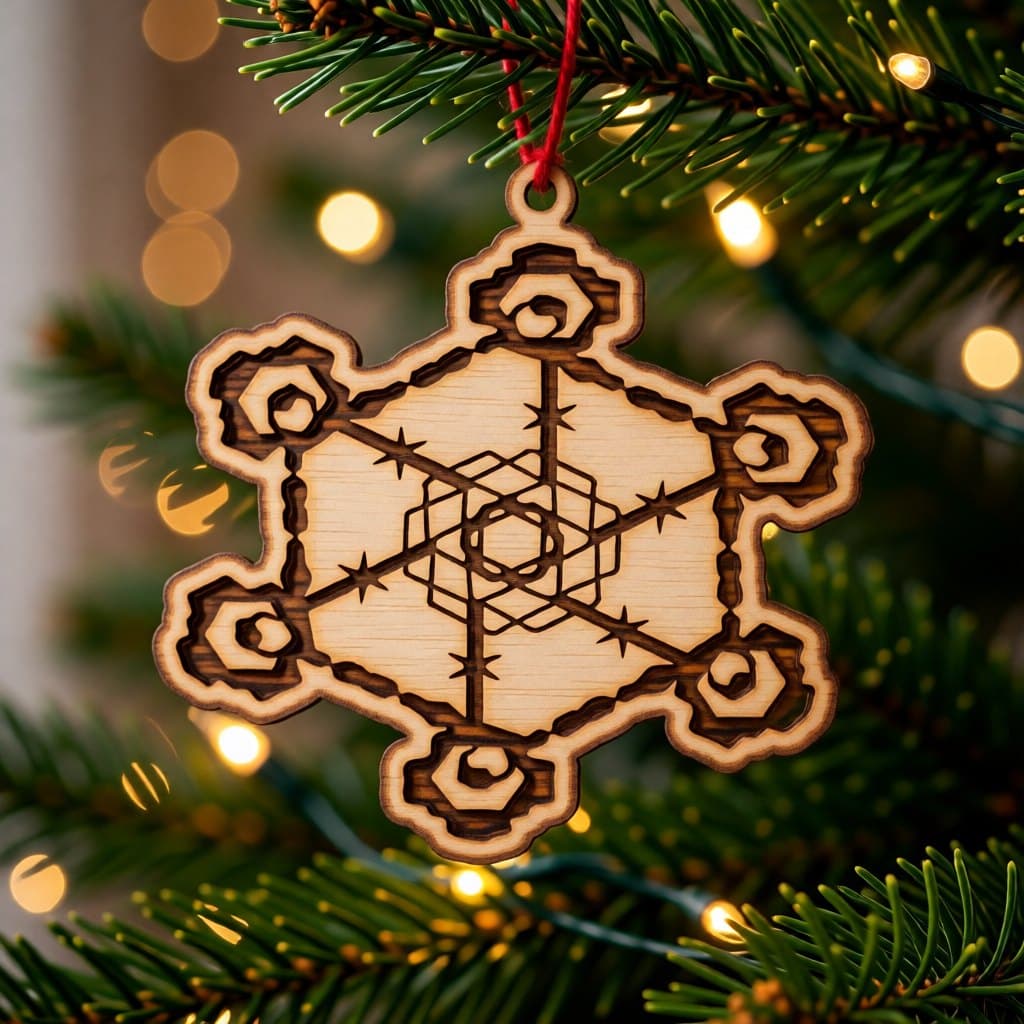
This snowflake is drawn like an ice crystal under a microscope: six chunky hexagon tips with a swirl inside, linked by beaded lines and crossed by three barbed spokes, with two overlapping outline hexagons at the core. At 90 × 88.2 mm (3.54 × 3.47 in) it mixes heavy solid areas with very fine linework, and a 4 mm hole above the top tip takes the ribbon.
- Formats
- SVG, DXF
- Size
- 90 × 88 mm (3.54 × 3.47 in)
- Parts
- 1
- Hanging hole
- 4 mm
- Cut length
- 0.38 m
- Engraving area
- 15.3 cm²
- Material
- 3 mm plywood, MDF or acrylic
- Est. time, 10 W diode
- 3 min 49 s
- Est. time, 40 W CO2
- 1 min 23 s
- Est. time, 100 W CO2
- 54 s
- Per 300 × 400 mm sheet
- 12 pcs
- Per 600 × 400 mm sheet
- 24 pcs
- Layers
- CUT (red), ENGRAVE (black)
- License
- CC0 1.0: free for personal and commercial use
Free account required to download
How to make it
- 01Import the file at full size (90 mm wide) and keep the single engrave layer as one fill pass so the hexagon tips and fine centre lines line up perfectly.
- 02Test on scrap and look closely at the nested hexagons in the middle; if they are pale, slow the engraving a little rather than adding power to the whole piece.
- 03Cut the outline last. It only wraps the six tips, so it is quick and drops the piece out cleanly.
- 04Lightly sand to remove residue from the fine lines, then hang the crystal from the hole above its top tip.
Looks like it came from a lab notebook
Real snowflakes are hexagonal plates and columns, and this design leans into that. Each of the six points is a solid, slightly rough hexagon with a curl of bare wood inside, like a crystal seen edge-on. Beaded lines run around the outside from tip to tip, and three straight spokes cross the centre, each with small barbs along its length. Right in the middle, two thin outline hexagons overlap around a little ring. It feels more like a science illustration than a greeting card.
Two kinds of engraving in one file
The solid tips and the hair-thin centre hexagons sit on the same layer, and that is the tricky part. Settings that give a rich dark tip can make the fine lines look faint or broken. Run a test and check the centre with a magnifier; if the lines are weak, slow the engraving slightly or give them an extra pass. The cut is short and simple, around 383 mm, because the outline only bumps around the six tips. A whole crystal, engraving plus cut, is estimated at 3 min 49 s with a 10 W diode, while a 100 W CO2 needs only 54 s (3 mm plywood).
Materials
Birch plywood shows both the bold and the fine parts well. Black acrylic engraved white, or slate-grey acrylic, gives a cold, icy look that suits the crystal theme.
Who it is for
- Science and chemistry teachers, as an end-of-term gift from the class.
- Weather fans and storm chasers who know what a real snow crystal looks like.
- School STEM fairs: hand them out with a card about why snowflakes have six sides.
- Ice-skating clubs and winter sports teams that want a less cute snowflake.
Questions about this file
Why do the centre hexagons look faint after engraving?
They are very thin lines on the same layer as the solid tips. Slow the engraving a little or run a second pass on that area only, and they come out crisp.
Is this a good gift for a science teacher?
It is one of the most fitting in the collection: the drawing is based on how real ice crystals form, with hexagonal tips and a hexagon core.
Can I engrave it on black acrylic?
Yes. On black cast acrylic the engraving turns frosty white, which makes the crystal look like ice. The cut works the same way.
Is the outline hard to cut?
No. The cut path is short and rounded around the six tips, with no thin bridges, so it is easy even on a small diode.
How many crystals per sheet?
With plain spacing a 300 × 400 mm sheet holds twelve crystals, and the 600 × 400 mm size holds 24.
Similar files